Saturday, October 11, 2008

Personal Action Plan 1: Creating a Food Index

How well do you know your food? Over the last two hours, I have gotten to know mine a lot better. I have just finished compiling an initial food index of every item of food in my house. A few stats that I found interesting. Out of 65 items:

  • 40% of my food is organic
  • 14% was purchased without packaging
  • 63% is contained in recyclable or reusable packaging
  • 15% has packaging that will eventually end up in the trash
  • The average distance my food traveled from its point of distribution to me is 1,030 miles (800 miles when not including the 5 international items)
  • 23% of my food is local, traveling less than 50 miles from its point of distribution to me
I will use this information as the basis for my personal action plan. Based on these initial calculations, I will try to increase the amount of my food that is organic, decrease the amount of food-packing waste I generate, and decrease the average distance my food travels. Further details on my personal action plan coming soon... 

Sunday, October 5, 2008

Bioregionalism

Tid bit from book review of Cities as Sustainable Ecosystems: Principles and Practices. Reviewed by Davidya Kasperzik, posted on worldchanging.org
  • "Cities as Sustainable Ecosystems is a compendium of lists and theories that is a useful reference and for some a potential guide to right living. The authors are enamored with the seminal principles of “bioregionalism.” Those include the notion that there are natural geographic boundaries and scaled biotic systems that can be the essential unit for sustainable living. Carrying capacity as a derivative of local resources, ecosystems, economic systems and culture is a theory that has substance to the authors and this reviewer. Getting the right balance, equilibrium if you will would be an outcome of conscious design, lifestyle choices, and a wise economic model."

I was instantly intrigued when I came across this passage. I have been attracted to planning issues on the regional scale for a few years now, mostly in the context of regional transportation and the live/work paradigm. This idea of bioregionalism - and the region as the appropriate scale for the exchange of human resources and systems, is almost tantalizing. What if all the food we ate and the things we bought and sold were exchanged within a few hundred mile radius? Would it ever be possible? I imagine that cities would have to condense to free up space for agriculture and industry. Instead of sprawling suburbs, what if there were strict city entities surrounded by circles of agriculture. Cities could be connected by regional trains - a nationwide puzzle of connect-the-dots. 


Friday, October 3, 2008

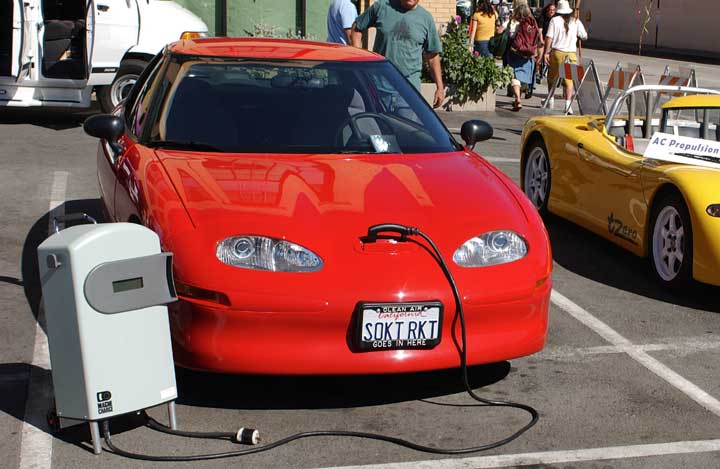
Who Killed the Electric Car?


Notes from movie: Who Killed the Electric Car? Viewed October 1, 2008


• Electric cars first invented in 1960's
• Every gallon of gas burned adds 19 lbs of CO2 to the air
• 1987- GM Sun Racer. Solar car prototype
• California Zero Emissions Vehicle Mandate -1990
• Saturn EV1 – the first commercial electric car
• Consumer doubts:
1. Are they strong, big and dependable?
2. Where do I charge it?
• Oil companies paid for editorials reporting negative testimonies about the car
• Framed as a wealthy person’s vehicle
• “You’ll never see a sexy lady or man leaning on an electric car. And well, that’s how they sell cars.”
• Hydrogen fuel cells – big competition – backed by car companies and lawmakers
• EV1’s purchased from dealer, then crushed in a junk lot in the middle of Arizona!
• Eventually only 78 Ev1’s left. Activists offered to buy them from GM, but GM wouldn’t sell.
• Who killed the E-car?
1. Consumers: Were they interested? Did they know it existed? Did they know the differences of the car? The environmental benefits?
2. Oil companies: lobbied for opposition to the electric car
3. Government: sued California to stop electric car. Influence of auto and oil industries.
• No change in car fuel efficiency since 1970’s
• 1987: 8.8 million barrels of oil imported per day
• 1005: 13.5 million barrels of oil imported per day
• OPEC nations agree to lower price of fuel in 1980’s (keeping the junkies addicted!)
• Japanese car companies began developing hybrid technology in response to US hybrid prototypes. US never released prototypes, while Japanese companies took over niche market
• “Clean cars are too important to be left to the auto industry”
4. Hydrogen fuel cell: still 15-20 years out. 5 miracles for hydrogen cars:
• cost $1 mil
• not enough room for hydrogen fuel
• fuel is expensive
• need fueling infrastructure
• competing technologies must not improve


Lecture Notes: Doug Holt


Notes from Lecture by Doug Holt, Oxford University - September 26, 2008

Marketing and social anthropology -> applying marketing perspective and analytical theory to social and environmental problems


- In order to reduce US CO2 output to be 'level with the rest of the world, the US would have to reduce CO2 output by 80-90% by 2040
- Why adpoting a personal green doctrine won't solve a national/global problem
* I find this really interesting - i have to agree that personal behavior and "good samaritan greenness" can only go so far. There has to be stronger incentives and more tangible consequences for changing collective behavior.
- What needs to happen from a policy perspective?
> Put a monetary value on carbon
> Value based on "badness" of CO2 generation
> Let the market take over - cap and trade scheme
- Why don't we have an effective social movement to instigate climate change?
> Nothing at the national level
- Critiquing WeCanSolveIt.org: climate change website
> Mass marketing campaign
> Al Gore as figure head presents problems -> Al Gore, a face with pre-set political implications
> Top-down fictitious march -> a cyber march. Why go all the way to Washington, when you can march online?
- Framing the movement: jobs/new economy, energy independence (kin to WWII, Apollo expeditions)
- Passive vs. active environmental/social diffusion (where people stand with environmental activism) The breakdown:
0.1% = Activists and scientists
10% = Local environmental activists
15% = Concerned passives
40 % = Weak knowledge, vaguely sympathetic
35 % = Anti-issue fatalists
> Cultural entrepreneurs instigate passive citizen sympathizers to become active
- Barriers to environmental social movement:
> Current cultural model of climate change (complexity, politicization)
> Current cultural model of mitigation (carbon consumerism, market naturalism, political culture)
> Leadership (lack there of)
> Efficacy (local v. national, no clear pathway to collective action)
- The US faith in science is not very deep
- Problem with "green laundry lists": free rider problem, measurement issues
- Reinventing the economy -> needs to happen! Not currently seen as an option
- Scale -> local action -> see and feel and touch 
- Structural limits -> cultural, political, physical... the list goes on...

Lecture Notes: James Howard Kuntsler


Notes from Chautauqua Lecture Series: Catastrophe or Opportunity? Climate and Energy Action Heroes Forum

Keynote speaker: James Howard Kuntsler
Chautauqua Auditorium - Sept 20, 2008


- The American dream/lifestyle is "the greatest misallocation of resources the world has known"
- The end of the suburban project -> we simply do not have the global resources to continue the American lifestyle
- The new American religion: the worship of unearned riches
- Technology DOES NOT EQUAL energy
- The "they'll come up with something" excuse
- Elite environmentalists are only having the 'technology conversation'
- Rediscovering the human urban habitat!
- SCALE (scale of everything - lifestyle, built env, consumption...)
- Passenger Railroad system!
- The airlines are dying!
- Towns that have an intimate relationship with agriculture will have an advantage in the future
- What is the appropriate urban scale?
- In the future, will we see a re-separation of urban and rural?
- America is full of places not worth caring about -> places not worth caring about are not worth defending
- Life is tragic -> history does not care if we destroy our own civilization
- It is up to us to generate our own hope!


Ideas for Personal Action Plan

Electricity use

Water use

Diet
- Food journal
- Organic vs. conventional: cost comparison, distance traveled, pollution generated from transport, pesticide amount
- Before and after comparison using GIS maps??

Consumption (packaging, materials)

Educating others in alternative transport
- Perhaps a pamphlet to hand out at new-student orientation
- Reasons to commute alternatively
- Maps to bike shops in Boulder
- Best routes to school
- Safety reminders
- On-campus transportation support

RE: Regional Planning Will Make the Problem Worse

Response to article posted on CULearn by Albert Bartlett: Regional Planning Will Make the Problem Worse (http://www.terrain.org/articles/4/bartlettclark.htm)

Is regional planning the solution or the problem?

"Smart growth is a means of making unsustainability as pleasant as possible." - A. Bartlett

I have to agree with the author that there really is no such thing as sustainable development and that population growth is the most formidable threat to a "more sustainable" human lifestyle. However, I strongly disagree that regional planning makes the problem worse. Regional planning is, unfortunately, a reaction to a problem in too many instances, but it does coordinate adjacent urban areas and facilitates better communication, transportation, and exchange of ideas between the areas. Population growth is inevitable, particularly in desirable locations such as the Front Range. Without regional planning to structure the inevitable growth, the outcome will be far worse.